
Real money gaming can illustrate simple when you see only your game screen But behind it, an account, payment system, gameplay, result, balance &
money transfer can all work together. This is why understanding how real-money online games work needs more than knowing how to play. The full process starts with an account and can move through funds, gameplay, result checking, balance updates, and withdrawal where legally allowed. In this guide, each stage is explained in simple words. You will also see how money is linked with gameplay, why an account balance may not always mean withdrawable money, and what can affect the overall process.
How Does the Real-Money Gaming Process Start?
The traditional real-money gaming process starts with a user account. The account gives the platform a way to connect the user’s details, activity, and account records.
1. Account Setup
Start by creating your account on the gaming platform.
The account can connect details such as:
- User profile information
- Game activity
- Account balance
- Transaction records
- Verification details
So, the account is not only used to enter the game. It can also connect the user’s game activity with the related account information.
2. Verification and Eligibility
Depending on the platform and its rules, the user may need to complete some checks before using certain features.
These checks can include:
- Age
- Location
- Account details
- Platform rules
- Applicable laws
For example, a player can create an account first but some features may remain unavailable until the required details are checked. This is why account setup is only the first step of the overall process.
In short: The traditional process starts with an account, followed by the required checks before the user moves to the next stage.
How Does Money Move Through the Gaming Process?
After the account stage, the traditional system could connect the account with funds where such transactions were legally allowed.
3. Adding Funds
Users could traditionally add funds through payment methods supported by the platform.
The basic flow is:
Payment Method → Payment Processing → Account → Balance
After a successful transaction, the amount could be added to the relevant account balance according to the platform’s rules.
For example, imagine a user’s applicable account balance is ₹0. If a permitted payment of ₹500 is processed successfully, the account may then show the updated amount.
The money does not simply go directly into the game.
The money is first added to the user’s account, and the next steps can depend on the payment method and platform rules.
The amount shown in an account may not always mean one type of money.
4. Understanding the Balance
A traditional platform could have different categories, such as:
- Deposited funds
- Promotional amounts
- Game-related balances
- Winnings
- Withdrawable funds
This is necessary. The amount visible on your mobile screen may not always be prepared for the withdrawal process.
For example,a balance of 1,000 does not necessarily mean the user can withdraw the entire amount.
In short: Funds traditionally move into the account through a payment system, while the balance shows the amount recorded under applicable conditions.
How Does Gameplay Connect With the Money?
Once funds were available in the traditional model, a user could participate in an eligible game according to its rules. The game system and money system can be connected, but they have different jobs.
5. Connecting Gameplay With the Account
The basic flow can be understood as:
Account → Funds → Gameplay → Result → Account Update
Different parts of the system can handle different tasks:
| Part | Main job |
| Account | Keeps user and account details |
| Payment system | Handles money transactions |
| Game system | Runs the game |
| Result system | Handles the game result |
| Balance system | Updates account information |
The exact process can differ between real-money games.
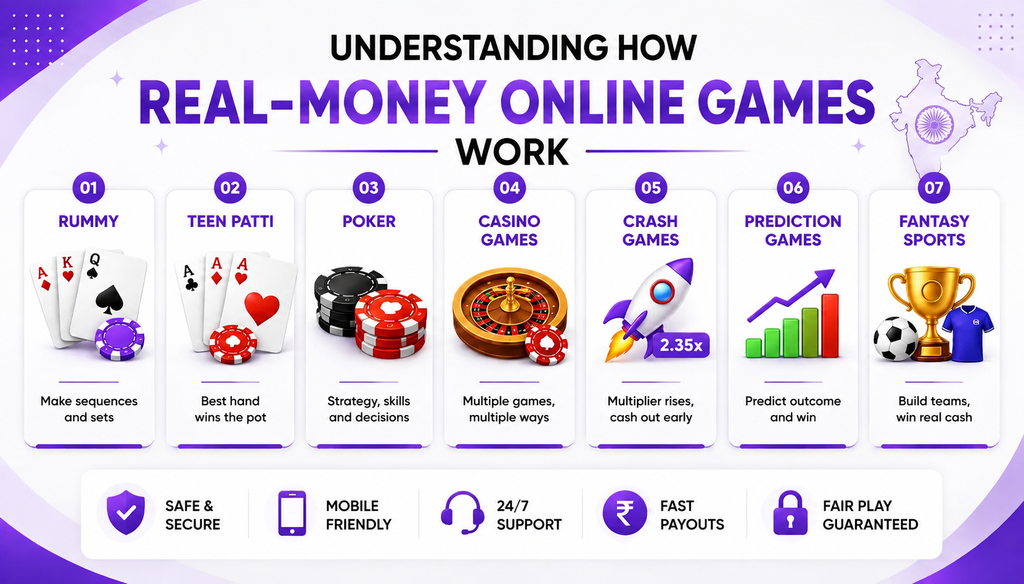
Some games may involve player decisions or skill. Others may use random events or another result method.
For example, imagine a game with a fixed way of creating a result. The user plays the game, the game produces an outcome, and the system then records the related information against the account.
This shows why how real-money games work is more than simply adding money and playing. Several parts can work together behind the screen.
In short: Gameplay creates the result, while the account and money systems record the information connected with that activity.
How are game result decided?
After gameplay ends, the result is handled according to the rules of that particular game.
6. Result Processing
There is no single result method for every real-money online game.
Depending on the game, the result may involve:
- Player decisions
- Skill or performance
- Random events
- A mix of different factors
The main point is that the result follows the rules set for that game.
The basic flow is:
Gameplay → Result → Account Record
For example, imagine a game that uses a set random system to create its outcome. Once the game reaches the result stage, that outcome is processed according to the game’s rules.
The related information can then move to the account or balance system.
This is where the result of the game becomes linked with what the user may see in their account.
In short: Each game has its own result method, and the final outcome can then be recorded in the related account.
What Happens to the Balance After the Result?
Once the result is processed, the account information can change according to the rules that apply.
7. Balance Update
Traditionally, a favourable result could increase the relevant balance. An unfavourable result could reduce the amount linked with the game activity.
But one point is very important:
The account balance is not always the same as withdrawable money.
For example, imagine an account shows ₹1,000 after a game result. The user should not assume that the full ₹1,000 can be transferred immediately.
The platform may treat different amounts in different ways. It may have separate amounts for deposits, promotional funds, winnings, or money that meets withdrawal conditions.
This is why terms like game balance, available balance, and withdrawable funds should not always be treated as the same thing.
Understanding this difference makes the money side of online real-money gaming easier to understand.
In simple terms,a game result may change your account balance,but the available amount may still be subject to certain withdrawal conditions.
What Happens When You Request a Withdrawal?
Traditionally, where real-money transactions were legally allowed, eligible funds could be requested for withdrawal through supported payment methods.
8. Withdrawal Request
The traditional flow could be:
Withdrawal Request → Verification → Platform Checks → Processing → Payment
A user may see an amount in the account and think it can be transferred right away. But some checks may still be needed.
These checks could include:
- Account verification
- Supported payment methods
- Transaction limits
- Processing rules
- Applicable fees
- Platform conditions
For example, if a user makes a withdrawal request, the platform may first check the account and the requested amount against its rules.
So, withdrawal is not always an instant transfer from the game to a bank account. It can be a separate step after gameplay and balance processing.
In short: Where legally allowed, eligible funds traditionally went through account checks and payment processing before reaching a supported payment method.
What Is the Complete Real-Money Gaming Process?
After looking at every stage, the full traditional process becomes easy to follow:
Account → Verification → Funds → Gameplay → Result → Balance Update → Withdrawal, Where Permitted
| Stage | What happens |
| 1. Account setup | The user’s account is created |
| 2. Verification | Required account and eligibility checks are completed |
| 3. Funds | A payment is processed and the related balance is recorded |
| 4. Gameplay | The user plays according to the game rules |
| 5. Result | The game creates and processes an outcome |
| 6. Balance update | Account information changes based on the result |
| 7. Withdrawal | Eligible funds could traditionally be requested where legally allowed |
This gives a direct answer to how real-money online games work.
The game is only one part of the full system. The account, payment process, gameplay, result, balance, and withdrawal process can all be connected.
The process can vary depending on the game and platform,but the basic steps are usually similar.understanding this traditional model makes the overall process easier to follow
In simple terms,it follow a clear path:creating an account,add funds,play the game,recieve the result,check the balance,and withdraw the available funds.
What Rules Can Affect This Process?
Because money is involved, rules can also affect how the process works.
Users looking at a real-money gaming service should check:
- Whether the activity is allowed in their location
- Age and eligibility rules
- Platform terms
- Payment and transaction rules
- Verification needs
- Privacy and account safety
India has also brought new rules for online gaming. Under the 2025 Act, online money games are not allowed, including their operation, promotion, and support. These rules have been in effect since may 1,2026
So, the process explained in this article describes the traditional operating model of real-money gaming systems. It should not be taken as confirmation that online money games are currently allowed in India.
In simple terms,the process may vary depending on your location,age,local laws,platform poloicies,payment,requriements,and account verification.
Conclusion
Understanding how real-money online games work is simple once the full journey is clear. Traditionally, the process moved from account setup and checks to funds, gameplay, result processing, balance updates, and withdrawal where legally allowed. You now know where money enters the system, how gameplay connects with the account, why a balance may not always mean withdrawable money, and what happens before withdrawal. The exact rules can differ by platform and location, but the complete process is now clear, easy to follow, and no longer confusing.
1. What happens first when someone starts the real-money gaming process?
The process usually starts with an account, followed by applicable eligibility and verification checks before funds, gameplay, or other account features can be used.
2. Why is account verification needed before using money-related gaming features?
Verification helps confirm account details and eligibility before certain money-related features are used. The exact checks can depend on the platform and applicable rules.
3. How does money move from a payment method into a gaming account?
A payment is first processed through a supported method. After successful processing, the relevant amount can be recorded in the user’s account balance.
4. Does deposited money go directly into the game?
No. Traditionally, deposited funds first become linked with the account balance. Eligible gameplay then uses the relevant account information according to the game’s rules.
5. Why can the balance shown in an account be different from withdrawable money?
A displayed balance can include amounts with different conditions. Deposits, rewards, winnings, and withdrawable funds may therefore be treated differently.
6. How does gameplay affect the account balance?
After gameplay produces a result, the relevant account information can be updated according to the game’s rules and the conditions linked with that activity.
7. Does every real-money online game use the same method for results?
No. Different games can use different result methods. Outcomes may depend on player decisions, skill, random events, or a combination of different factors.
8. What happens after a real-money game produces a result?
The result is processed according to the game’s rules, and relevant information can then be passed to the account or balance system.